Share
Attachments
Transport_Sectoral Report_FR_FINAL_may13_0.pdf
Mines_Sectoral Report_FR_FINAL_may13_0.pdf
Exploitation forestière_Sectoral Report_FR_FINAL_may13_0.pdf
Energie_Sectoral Report_FR_FINAL_may13_0.pdf
Agriculture_Sectoral Report_FR_FINAL_may13_0.pdf
Transport_Sectoral Report_FINAL[web]_may13_0.pdf
Mining_Sectoral Report_FINAL[web]_may13_0.pdf
Logging_Sectoral Report_FINAL[web}_may13_0.pdf
Biomass Energy_Sectoral Report_FINAL[web]_may13_0.pdf
Agriculture_Sectoral Report_FINAL [web]_may13_0.pdf
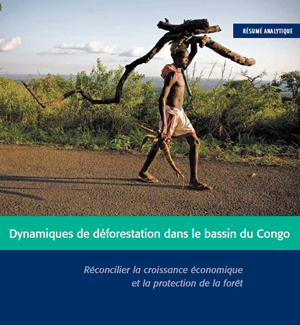
Dynamiques-deforestation-Congo-FR-resume_0.pdf
DeforestationTrendsCongoBasin-ExecSumm-English_0.pdf
Dynamiques-de-déforestation-final_0.pdf
Deforestation in Congo Basin_full report_feb13_0.pdf
Authors/Partners
World Bank Africa Region, COMIFAC, International Institute for Applied Systems Analysis, PROFOR, Norwegian Trust Fund for Private Sector and Infrastructure, UK Government, Trust Fund for Environmentally and Socially Sustainable Development, Forest Carbon Partnership Facility.Author: Carole Megevand, with Aline Mosnier, Joël Hourticq, Klas Sanders, Nina Doetinchem, and Charlotte Streck.
Economic Growth and Drivers of Deforestation in the Congo Basin
CHALLENGE
Though the deforestation rates in the Congo Basin countries have historically been low, the trend is likely to change dramatically due to the combination of many different factors: population increases (and associated expansion of subsistence agriculture and fuelwood collection); local and regional development; and the rise in global demand for commodities.
The countries of the Congo Basin face the dual challenge of developing local economies and reducing poverty, while limiting the negative impact of growth on the region's natural capital.
APPROACH
PROFOR supported an in-depth, multi-sectoral analysis of the major drivers of deforestation and forest degradation for the next decades in all six of the Congo Basin countries (Cameroon, Central African Republic, Gabon, Democratic Republic of Congo, Equatorial Guinea and Republic of Congo). The overall study was led by the World Bank Africa Region. A team from the International Institute for Applies Systems Analysis (IASA) led a modeling exercise, based on the GLOBIOM model but tailored to the Congo region, to investigate drivers of deforestation by 2030 and assess the impacts of various "policy shocks" (such as: increased international demand for biofuel; improved transportation infrastructure; improved agricultural technologies; etc). The approach also relied heavily on the inputs from multi-stakeholder regional workshops and in-depth sectoral reports (available on this page).
MAIN FINDINGS
- Deforestation rates are likely to increase in the future to sustain development and poverty reduction.
- Increasing agricultural productivity is not sufficient to limit pressure on forests.
- Wood extraction for domestic fuelwood or charcoal production will continue to grow for the next few decades and could create a massive threat to forests in densely populated areas.
- The development of much-needed transportation infrastructure could lead to major deforestation, mainly by changing economic dynamics in newly accessible rural areas.
- The pressure from formal logging is limited, but informal chainsaw logging is expected to progressively degrade forests.
- Mining—a largely untapped source of income and growth—could also lead to significant impacts when the sector develops.
MAIN RECOMMENDATIONS
The study highlights options to limit deforestation while pursuing inclusive, green growth. Emerging environmental finance mechanisms, such as reducing emissions from deforestation and forest degradation (REDD+), may provide additional resources to help countries protect their forests. But there are already a number of “no-regrets” actions that countries can take to grow along a sustainable development path:
- Participatory land use planning could help clarify tradeoffs among different sectors, encourage the development of growth poles and corridors, and direct destructive activities away from forests of great ecological value.
- Unlocking the potential of the Congo Basin for agriculture will not necessarily take a toll on forests: the Congo Basin could almost double its cultivated area without converting any forested areas. Policy makers should seek to target agricultural activities primarily towards degraded and nonforested land.
- In the energy sector, putting the woodfuel supply chain on a more sustainable and formal basis should stand as a priority. More attention should be paid to responding to growing urban needs for both food and energy through intensified multi-use systems (agroforestry).
- Better planning at the regional and national levels could help contain the adverse effects of transportation development, through a multi-modal and more spatially efficient network.
- Expanding sustainable forest management principles to the booming and unregulated informal logging sector would help preserve forest biomass and carbon stocks.
- Setting “high standard” goals for environmental management of the mining sector could help mitigate adverse effects as the sector develops in the Congo Basin.
See also: Main recommendations by sector (English) - Recommandations principales par secteur (français)
RESULTS
The results from the modeling exercise were shared over the years: at the UNFCCC Conference of Parties 15 in Copehagen, at the World Bank in January 2010 and February 2013( "SDN week" ) and at multiple regional conferences and workshops (Kinshasa, Douala, Brazzaville 2009-2012; final regional conference in Kinshasa, May 2013 - see conference presentations here).
The findings have helped Congo Basin countries better understand the diversity of factors of deforestation --beyond logging -- and the impact of indirect external factors such as global commodity demand.
The knowledge generated from this activity is critically important as Congo Basin countries prepare their REDD+ and broader development strategies. If countries are able to minimize forest loss as their economies develop, they could "leapfrog" the steep drop in forest cover that has historically accompanied development in many countries, and make an important global contribution to climate change mitigation.
For stories and updates on related activities, follow us on twitter and facebook , or subscribe to our mailing list for regular updates.
Author : World Bank Africa Region, COMIFAC, International Institute for Applied Systems Analysis, PROFOR, Norwegian Trust Fund for Private Sector and Infrastructure, UK Government, Trust Fund for Environmentally and Socially Sustainable Development, Forest Carbon Partnership Facility.Author: Carole Megevand, with Aline Mosnier, Joël Hourticq, Klas Sanders, Nina Doetinchem, and Charlotte Streck.
Last Updated : 06-15-2024