Share
Related Links
Keywords
Authors/Partners
Intercooperation Andean Office, CONAP, INAB, Veduria Forestal Communitaria
National Timber Yield Tables for Mahogany
Technical Assistance for the Development of the National Timber Yield Tables for Mahogany (Swietenia macrophylla) Standing Volume & Export Grade Sawn wood
CHALLENGE
Mahogany (Swietenia macrophylla) is the single most valuable tropical timber species in international trade. It is also one of the most important tropical species subject to selective harvesting.
Over-harvesting and illegal logging of this species led to its listing in Appendix II of the CITES Convention. Market studies show that the largest proportion of mahogany is exported to the United States, France, Canada, England, Dominican Republic and other European countries. Despite conservation, supervision and control efforts the impact of mahogany overharvesting and illegal logging has contributed to the species' rapid commercial extinction in many areas of its natural distribution.
The use of inaccurate conversion factors for calculating export grade sawn wood yields from standing timber estimates is frequently used to “launder” illegally harvested mahogany. The resulting projection of export grade sawn wood overstates the volumes actually produced from legally harvested trees of both species. These inflated figures help to justify additional CITES export permits which are used to facilitate the export of timber of illegal origin.
The same fate also applies to Spanish cedar (Cedrela Odorata) also included in CITES Appendix III. In some countries, Spanish cedar trade has skyrocketed in the last three years. If harvesting trends and the extent of illegal logging continue at the same pace, Spanish Cedar will follow mahogany's detrimental patterns.
APPROACH
Accurate conversion factors for standing timber and export grade sawn wood are crucial for the effective implementation of the CITES convention.
Guatemala’s CONAP and INAB, government agencies for protected areas and forest administration respectively; and Peru’s OSINFOR, forest control and supervision government agency, have requested technical assistance from Intercooperation and PROFOR's FLEG team at the World Bank to develop their national yield tables.
Technical assistance activities related to the development of national tables are expected to take place in Guatemala City and in selected forest concessions of Peten, Guatemala targeting relevant staff from CONAP, INAB and forest concessionaires. Desktop work will allow field data input, calibration of the model, definition of product classifications and development of the timber yield tables and statistical calculation.
In Peru, support and technical assistance to the Veduria Forestal Comunitaria activities will relate to monitoring, over sightings and obtaining lessons learned from at least two cases within forest industry-indigenous community timber commercial contracts, to prevent illegal logging and unsound social practices impacting local communities of Pucallpa, Atalaya and Contamana.
This activity has supported the following progress in Guatemala:
- Field work (identification, selection and data collection) in five (5) mahogany production units: La Union, Chosquitan, Rio Chanchin, Carmelita and Afisap totaling about 18,000 hectares in El Peten, Guatemala.
- Field work was followed by extensive data processing, regression analysis and development of volumetric conversion factors. Based on this analysis, total average volume of export grade sawn wood including branches for mahogany in Guatemala is approximately 3.328 m3 per tree.
- CONAP (Guatemala's CITES authority) has fully incorporated the newly developed national yield table in its country report.
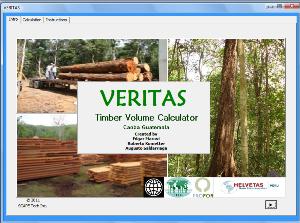
- Development of a simple data processing software known as the VERITAS Timber Volume Calculator which can determine in real time the expected sawn wood volume of a given tree in all export timber grades -- with potential application for other timber species.
In Peru, assistance for Verduria Forestal Communitaria Activities resulted in monitoring of logging contracts and technical assistance to 33 indigenous communities in Contamana and Atalaya provinces. The team reviewed and provided training on issues such as forest management plans, permits, contracts, operations, volume calculation, payments, etc and also assisted communities facing forest land tenure problems (resulting from logging forest concessions overlapping with community land).
Monitoring the implementation of 11 logging contracts revealed a consistent pattern of inequality and lack of transparency in contract terms and conditions that had significant impacts on community livelihoods and the environmental conditions of their natural resources. For example:
- Logging industry focus was on selective and overexploitation of only two or three species of high commercial value
- In several cases, logging took place without permits
- Jobs were mostly given to outsiders
- Benefits to the communities were accrued in actual timber (20 to 30% of extracted volume), often resold to the logging industry at discounted prices
- Logging industry used permits, obtained on behalf of the indigenous communities, to launder illegally harvested timber, making communities liable for those illegal activities
Material collected from these experiences will serve as baseline information for the development of guiding principles and criteria for monitoring logging contracts in Peru and beyond.
Additional results and products will be shared on this page when they become available. You can also follow us on twitter (twitter.com/forestideas) or subscribe to our mailing list for regular updates.
For stories and updates on related activities, follow us on twitter and facebook , or subscribe to our mailing list for regular updates.
Author : Intercooperation Andean Office, CONAP, INAB, Veduria Forestal Communitaria
Last Updated : 06-16-2024